[RDPLINE Use Case] One API, One Contract: How a Korean Platform Feeds News to Its AI Agent
2026. 11. 02
[RDPLINE Use Case] One API, One Contract: How a Korean Platform Feeds News to Its AI Agent
Connecting one news outlet to an AI agent is easy. The trouble starts when you need a dozen Korean outlets, across several channels, for both training and live answers.
A large Korean platform company runs an AI agent across its app and multiple devices. When a user asks "What happened today?", the agent answers from the latest news and surfaces summaries of the top stories. BECUAI supplies the news data layer behind it through RDPLINE, the licensed pipeline to the Korean press.
Challenge 1: every new outlet adds operational load
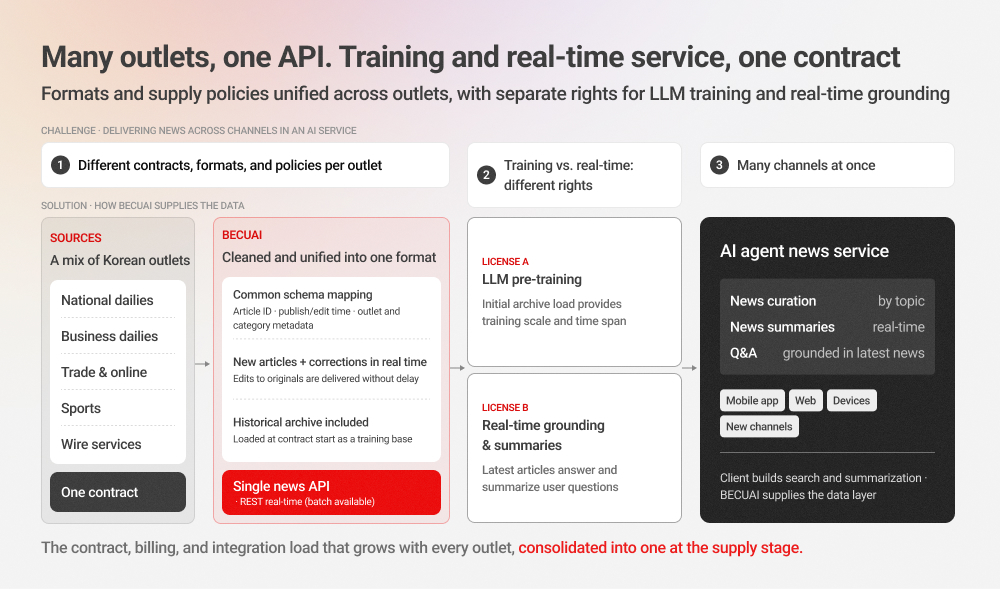
National dailies, business dailies, trade publications, sports outlets, and wire services each come with their own formats, supply policies, and contract terms. Managing them one by one means contracts, billing, integrations, and incident response all scale with the number of outlets. With multiple channels on top, that load only grows.
Challenge 2: training and real-time service need different rights
The same article needs a different scope of rights depending on whether it is used to train an LLM or to ground a real-time answer to a user's question. If the two aren't separated from the start, every new channel or use case means checking rights again.
Solution: one API, one contract, two sets of rights
- Multi-outlet API: articles from a mix of Korean outlets are mapped to a common schema (article ID, publish and edit timestamps, outlet and category metadata) and delivered through a single REST API.
- Rights by use: within one contract, rights for LLM training and rights for real-time grounding and summarization are defined separately.
- Corrections in real time: not just new articles, but edits to articles already published are delivered and flagged.
- Initial archive load: a real-time feed alone can't provide the scale training needs, so several years of historical articles were delivered at contract start.
Corrections matter more than they seem. An AI agent that repeats a story after it has been corrected loses user trust fast.
The roles were clear. The client builds its own news search and summarization features. BECUAI supplies the news content and API those features run on.
The outcome
Contracts, billing, integrations, and incident response that used to be split by outlet now run through one channel. The client's news curation and real-time summaries use the same data layer across every channel, and adding a channel no longer requires any work on the data side.
The takeaway
The more channels a service has, the more it gains from a single supply channel instead of one contract per outlet. And it pays to separate training rights from service rights in the very first contract.
Building an AI agent that needs Korean news? Let's scope the outlets and the rights for each use together.
_썸네일.jpg)
_썸네일.jpg)